

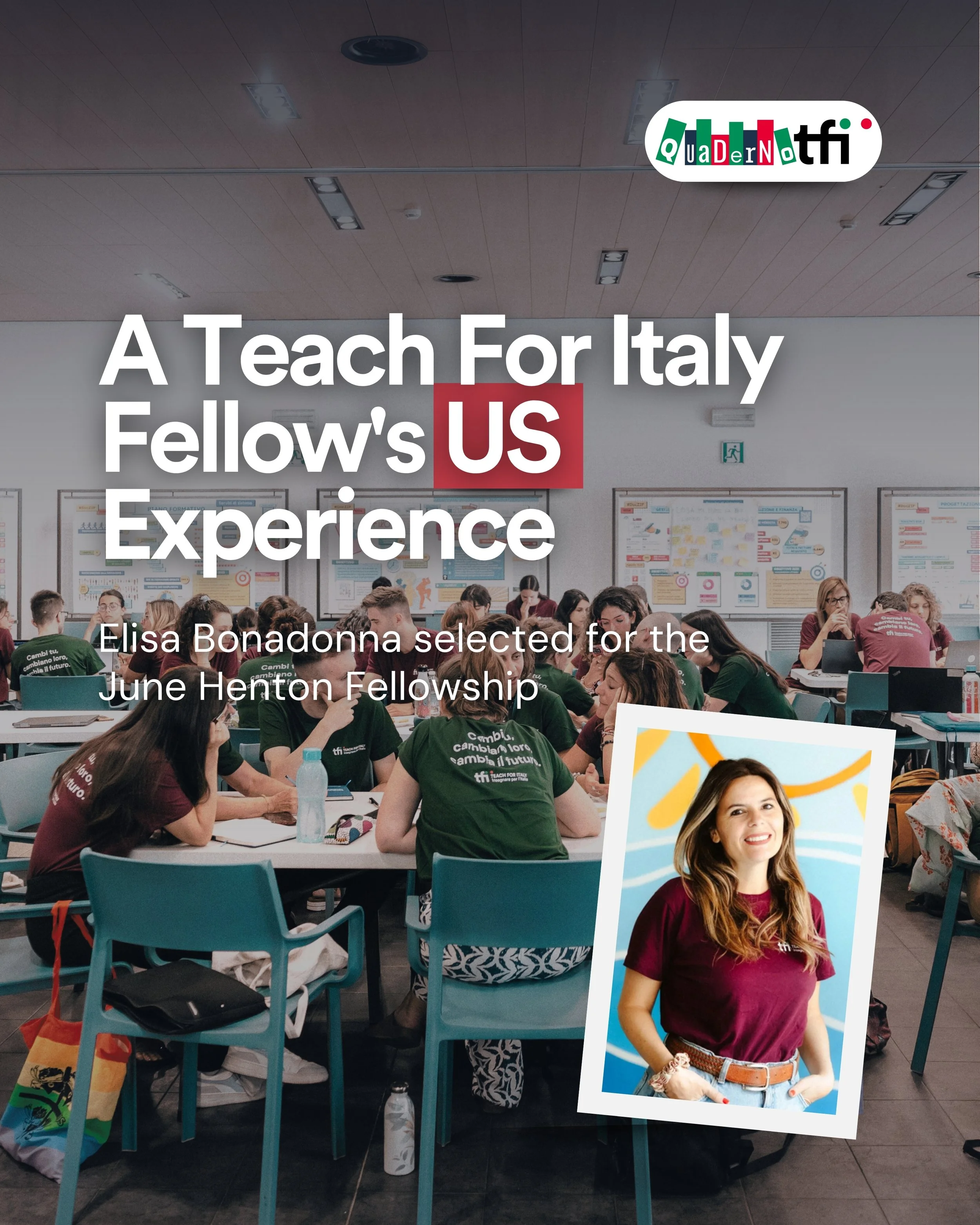
A Teach For Italy Fellow's US Experience
Elisa Bonadonna selected for the June Henton Fellowship
What happens when collective leadership expands beyond the classroom and becomes a bridge between countries, schools, and communities? It happens that a story born in an Italian classroom can intertwine with a global vision of educational equity.
In our daily work at Teach For Italy, we believe that countering educational inequalities also means opening windows to the world. It means offering our Fellows not just teaching tools, but the opportunity to view school as a space for shared responsibility and systemic impact.
It is within this horizon that the journey of Elisa Bonadonna unfolds. Selected for the 2025 Fellowship, she is also the recipient of the June M. Henton Scholarship, a grant promoted by Friends of Teach For Italy that will offer Elisa:
The two-year Teach For Italy Fellowship program.
Additionally, the chance to live a cultural and growth experience in the United States. This is an opportunity that strengthens the link between the local and the global, between the challenges of Italian schools and the comparison with other educational systems.
The Fellowship is designed as a transformative journey, capable of generating change not only in classrooms but also in local territories. Experiences of this type represent a space for dialogue and growth that fuels the collective impact we are bringing.
The Legacy of June Henton: A Bridge Between Italy and the United States
The June M. Henton Fellowship was created to honor the memory of Dr. June Henton, a founding board member of Friends of Teach For Italy and a key figure in promoting international cooperation in education.
A pioneer of exchange programs between Europe and the United States, June Henton dedicated her life to building bridges between universities and countries. Her initiatives included creating Auburn University's first international campus in Ariccia—which has hosted hundreds of American students in Italy and contributed to the city's economic development—and founding the global network Universities Fighting World Hunger, in addition to being recognized as a White House Champion of Change in 2012.
The scholarship fully supports a teacher-fellow for the 2025–2027 biennium, covering program participation costs up to $25,000. However, its value goes far beyond financial support, as it represents an investment in the vision and possibility of building a fairer education beyond national borders.
The Exchange Opportunity
During the summer between the first and second year of the Fellowship, Elisa will be hosted in the United States by Friends of Teach For Italy. She will have the opportunity to get to know the American educational system firsthand, meet educators, visit university campuses, and engage with the Teach For America and Teach For All networks.
She will be able to closely observe different contexts—equally complex and innovative—allowing her to study how other systems address structural inequalities and to gather practices and tools to bring back to her experience with Teach For Italy in Italian classrooms.
This experience will strengthen her path as a collective leader, a figure capable of acting not alone, but together with students, colleagues, families, and communities. Because educational equity is not an individual goal, but a shared process.
Elisa's Words
This experience was born to open new perspectives. What learning spaces or international dialogues do you hope will help you grow as a collective leader during the next two years of the Fellowship?
"During the next two years of the Fellowship, the most essential and precious growth space for me will be the constant dialogue with other Fellows and the Alumni network. It is a community of peers where one can share questions, difficulties, and educational visions, but above all, learn from the best teaching practices developed in different contexts and schools. I deeply believe in the value of horizontal learning and the possibility of building a collective and widespread leadership that stems from mutual listening, the exchange of experiences, and shared reflection on educational action.
Alongside this, I feel my relationship with my city's territory is very important, particularly with the neighborhood where I live, Barriera di Milano in Turin. Interacting with the educational, social, and cultural realities of the area means recognizing the school as part of a wider ecosystem, where education, citizenship, and social justice are deeply intertwined. It is in this continuous dialogue between school and territory that I feel I can develop a leadership capable of responding to the real needs of communities, valuing their resources and skills.
In this journey, the international comparison between Italy and the United States represents a precious and profoundly transformative learning space. In particular, the dialogue with Teach For America, with Friends of Teach For Italy, and with the American schools I will have the opportunity to visit during the Fellowship will be a great contribution to me. These exchanges will allow me to engage with educators working in complex, highly diverse contexts, observe different organizational models and educational practices, and reflect on the role of the school as a lever for equity and social change.
For me, however, the value of international comparison lies above all in the possibility of bringing home what I have learned, transforming it, and adapting it to the school context where I work. My goal is that these exchange experiences do not remain isolated, but become concrete resources to enrich daily educational practices and contribute, together with other educators, to a fairer, more aware school that is rooted in its territory!"
On which themes of the educational world would you like to have a dialogue with other cultures/countries?
"One of the themes I feel is most urgent in my educational path is the valuation of cultural differences. In Italy, the debate often focuses on inclusion and 'coexistence' between cultures, as if diversity were a fragile balance to be monitored to prevent conflict. This approach, while born from good intentions, risks reducing differences to something to be managed rather than recognized and empowered.
I believe that although important steps have been taken regarding inclusion, in Italy we are still far from a vision in which cultural differences become an active resource for learning, identity building, and the strengthening of school communities.
For this reason, I would like to compare our context with that of the United States—a country characterized by strong demographic and cultural complexity—to understand how schools face this plurality daily. I want to explore which educational practices, curricular choices, and languages allow us to go beyond simple tolerance, instead favoring a sense of shared belonging that does not erase differences but makes them visible and significant.
As a learning support teacher, I am also particularly interested in how this professional figure is valued within the American school system. In Italy, support represents a key piece of inclusion, but it often remains confined to a function of mediation or individual support, and in some cases ends up merely serving as a frame for the work of curricular teachers. I would like to understand the duties, professional recognition, and educational role of the support teacher in the United States, and how their work is integrated into a truly shared vision of educational co-responsibility.
Another central area of interest concerns transversal subjects, particularly those related to gender equality, the culture of peace, and respect for the planet. I believe these themes cannot be relegated to occasional moments or extracurricular projects, but must structurally run through the school experience. In this sense, I want to delve into how other educational systems manage to weave together disciplinary knowledge and civic skills, forming conscious, critical, and responsible students. Finally, I feel a strong desire to discuss the theme of affective and emotional education. I am interested in understanding how it is addressed in American schools, what space it is given, and how it contributes to the development of healthy relationships, respect for others, and the construction of an inclusive educational climate. I believe that investing in affective education means working at the roots of inequalities and conflicts, promoting a school capable of not just transmitting knowledge, but of forming people."
