

From Teacher to Strategic Consultant
How the skills gained during the Teach For Italy Fellowship program become an asset in the professional world. An interview with Giovanni Caccia Dominioni on bridging the gap between school and business.
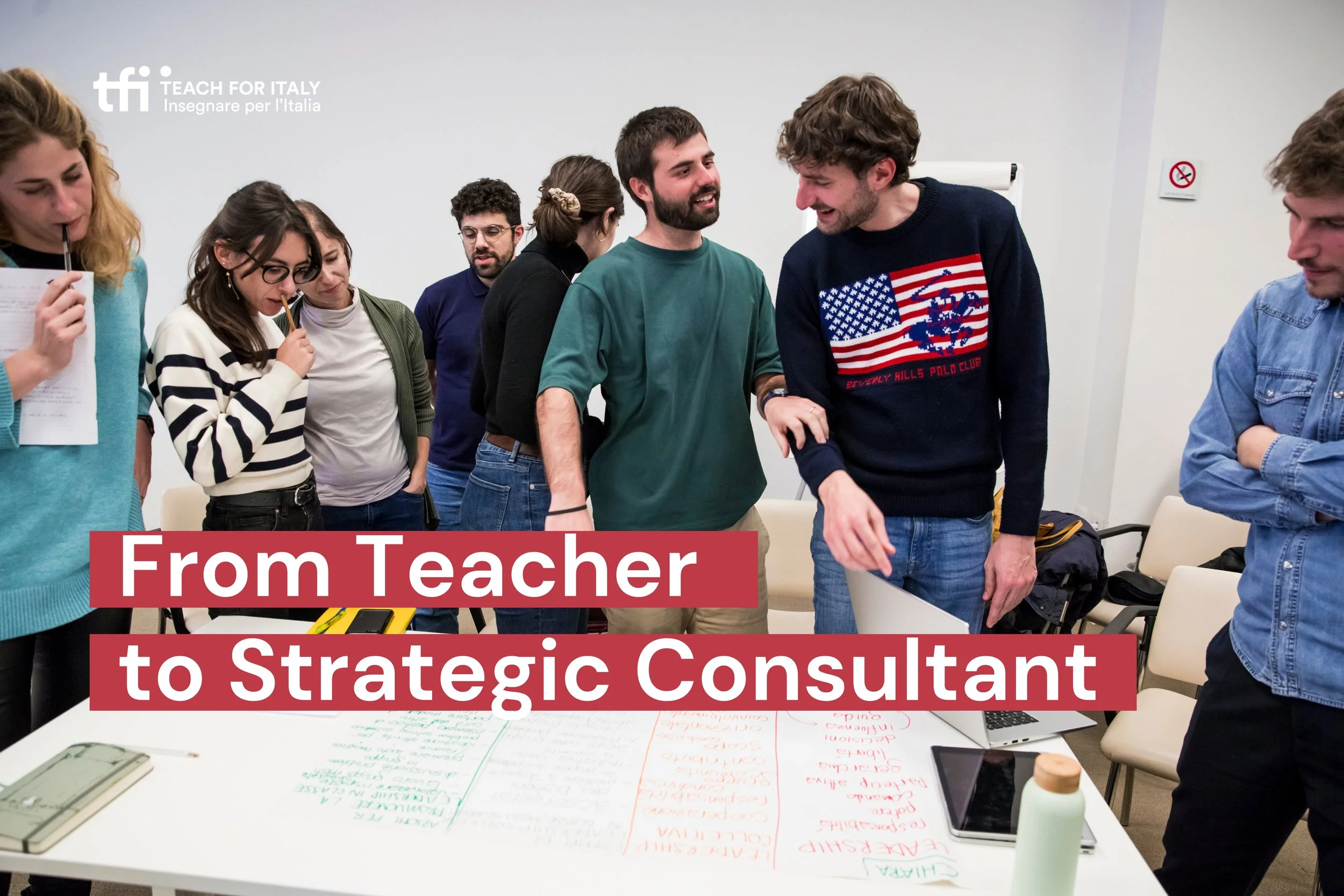
What do managing a complex classroom and corporate strategic consulting have in common? Much more than one might think. The Teach For Italy Fellowship program is not just a teaching experience, but a transformative journey that trains participants to navigate complexity and join forces toward a collective goal.
In this interview, we meet Giovanni Caccia Dominioni, a 2022 Teach For Italy Alumno, who has brought the skills developed in the classroom into the corporate world. From the need to break down the "silos" between schools and businesses to projects aimed at redesigning the future of work, Giovanni tells us how collective leadership can be the key to generating social innovation while contributing to a fairer school system for everyone.
An authentic testimony that reminds us that investing in education is not charity, but a vital strategic choice for the health of our entire national system. Because, quoting Don Milani, the true changemaker is the one who chooses to "emerge from it together."
How has your experience as a Teach For Italy Alumni influenced your approach to work within a context like strategic consulting? Are there specific skills or mindsets you feel you brought with you from the classroom to your current role?
Teaching with Teach For Italy taught me one thing above all: you cannot achieve results if you don’t understand who is in front of you and how to get them to collaborate. In a difficult classroom, if you don’t have a big-picture view of what is happening between the desks, you won’t get anywhere. Today, in my work, I try to do the same. If in the classroom I had to connect students, families, and colleagues toward a common goal, today I do it between different stakeholders (institutions and companies). My mindset is focused on networking among people who often speak different languages.
In your opinion, how can businesses contribute to a more equitable and inclusive education?
In my view, the main problem is that schools and businesses live in separate bubbles that do not communicate. Business can do a lot for educational equity, but it must stop seeing school as something "other," because companies have a vital need for schools to function. A school that fails to innovate or leaves talent behind creates a vacuum of skills and vision that directly damages the labor market. Breaking down silos means understanding that the health of a company tomorrow depends on the quality of education today; it is a strategic investment, not charity.
During the Fellowship, there is a strong focus on the concept of collective leadership. How does this principle translate, for you, into a corporate context? Have you had the chance to experience or promote collaborative dynamics that reflect this vision?
Open Jam is, for me, the concrete example of what collective leadership means in my current role: it is a platform where we bring young workers, students, and managers to the same table to co-design the future of work. Here, leadership is collective because hierarchy doesn't matter; what counts is the strength of ideas and the ability to work together. The mission we set for ourselves at Open Jam is very ambitious: to create a world of work where people can be happy! We know that this goal only becomes possible through true cross-sectional and intergenerational involvement.
Looking at your current experience, how do you imagine the role of professionals and companies in combating educational inequalities in Italy? How does the Teach For Italy experience continue to guide your choices and your idea of impact?
Today, I feel that my task as a professional is to act as a bridge. I cannot see my work as separate from the social context in which I live. The Teach For Italy experience left me with the awareness that educational inequalities in Italy are a drag on everyone, not just those who suffer them directly. What continues to guide my choices and my idea of impact are the words spoken long ago by the great educator Don Milani: “I learned that other people's problems are the same as mine. To emerge from them together is politics. To emerge from them alone is avarice.”
