

Teaching by building community in Sicily
From tackling school dropout to building community. Davide’s journey in a school in Sicily
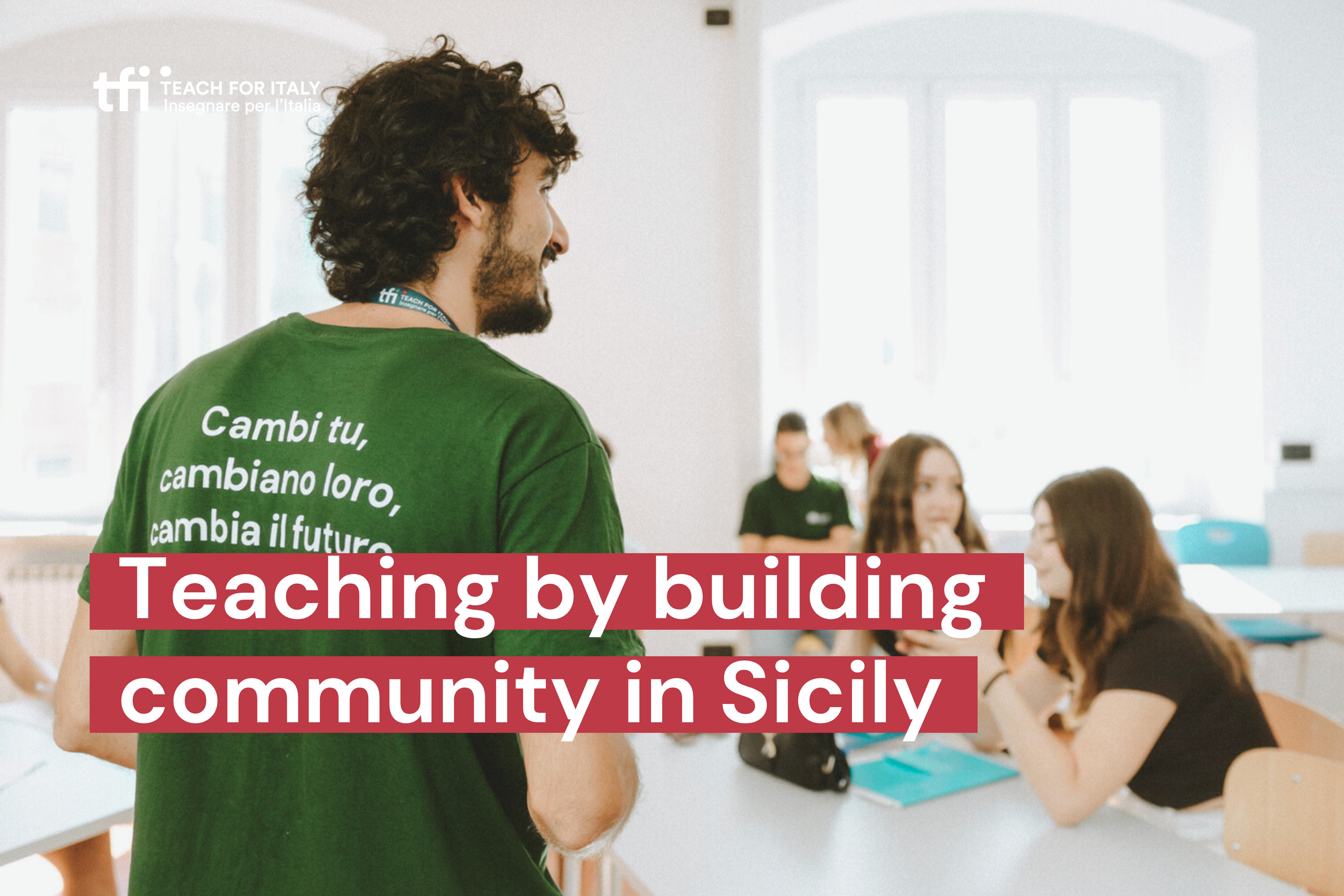
What does it mean to teach today in a territory that struggles every day against depopulation and narratives that seem to leave little room for change? And how can a teacher transform these challenges into an engine of possibility?
In this interview, we met Davide De Salvo, 2025 Teach For Italy Fellow and part of the "Modello Sud e Isole" (South and Islands Model) initiative, who has been working since September at the IISS Lercara Friddi, in the heart of Sicily.
His experience takes us inside a school that welcomes and builds through resilience. A place where the relationship between teachers, students, and the territory becomes a lever to combat school dropout and to imagine new horizons together.
Davide tells us what pushed him last year to apply for the Fellowship program, how he is redesigning his idea of teaching as a tool for social justice, and what role public schools can play in restoring an authentic sense of possibility to the young men and women of Southern Italy.
What motivated you to apply for the Teach For Italy Fellowship program, and how is this experience with the "Modello Sud e Isole" initiative transforming your vision of the role of the teacher and the public school?
My interest in the Fellowship arose from observing, based on my own experience as a student, the very same educational disparities that Teach For Italy aims to combat. I felt the desire to get involved and explore how teaching can become a tool to fight the systemic injustices that still afflict public schools.
Through the "Modello Sud e Isole" initiative, I have the opportunity to engage directly with the potential and the difficulties of schools in Sicily. In a context characterized by high youth unemployment and the progressive depopulation of inland towns, I believe a change in narrative perspective is crucial. Our students shouldn't feel obligated to leave their homeland; they must have the opportunity to choose, even to stay, if they wish to do so. To achieve this, it is fundamental that schools are able to cultivate a sense of possibility and self-efficacy in every student, so they can become active protagonists of their own future.
How would you describe your role within the IISS Lercara Friddi, and how are you contributing, together with the teaching staff, to countering school dropout and strengthening the bond with the local community?
From the beginning of my experience at IISS Lercara Friddi, I had the privilege of being warmly welcomed by the entire school community. This favorable climate allowed me to establish a constructive dialogue with numerous teachers, facilitating the sharing of impressions, ideas, and best practices. In the first three months, the collaboration and synergy with the School Principal and the teaching staff have been a clear sign of a shared educational vision, which is being built together day after day.
My role focuses on three strategic areas — classroom, school, and territory — which are fundamental to effectively countering school dropout, whether explicit or implicit.
In the classroom, together with the teachers, I co-design orientation-based educational activities aimed at developing specific medium-to-long-term goals in the students. In parallel, we actively work on developing their emotional intelligence.
At the school level, I regularly meet with other teachers to analyze specific needs, reflecting on the most effective methodologies and tools to adopt based on the students' needs.
In the territory, I connect daily with the population, seeking an open dialogue about the school. I listen to understand how the school can evolve, according to their perception, into a true "cultural outpost" without physical barriers.
What changes or results do you hope to see in the next two years thanks to the Modello Sud e Isole initiative?
First and foremost, I hope that my students become conscious actors, capable of inspiring and spreading seeds of change not only within their classroom but throughout the school and their territorial context. Furthermore, I hope for the construction of a community that actively participates in education, not limiting itself to its own children, but investing in the future of the territory, which will depend on them.
What is the most important impact a teacher can generate in territories like Southern Italy?
In my opinion, teachers in Southern Italy should act following the three dimensions I mentioned: classroom, school, and territory.
In Southern Italy, and particularly in Sicily, we are unfortunately hindered by a constant narrative of social and cultural immobility that has oppressed us for generations, suggesting that nothing will change.
As teachers operating in peripheral and marginalized contexts, we have the responsibility to educate students to recognize the roots of these disparities. We must reflect with our students and our communities on effective and sustainable solutions, breaking with that Gattopardo mentality that has dominated our identity for too long, thus limiting our actions.
